By Devin Smock
A screener of Dead of Night was provided for review purposes.
SPOILERS THROUGHOUT
Dead of Night gets a few things right almost immediately. It does not waste much time before giving us a masked killer, a young woman running for her life and the sort of opening murder that tells us exactly what kind of movie we are watching.
Unfortunately, it also gives us a young woman who could keep running but decides to hide so the killer can find her. Slasher tradition. The scene is clearly playing in the Scream sandbox, right down to an actual reference, but the camera panning up into the title works. Better yet, the reveal of Linda Mitchell’s mutilated body hanging from a light pole is outstanding. The effects team delivers one of the film’s best images before most of the characters have even been introduced.
Then Linda’s mother and father arrive and see the body.
That is a brutal idea. It should leave a hole in the movie. Instead, only a few hours later, Mayor Mitchell is holding a press conference, residents are furious that Sheriff Weaver has not solved the murder and everybody is behaving as if the town has been waiting three months for answers. People respond to grief differently, sure, but the movie never convinced me this woman could watch her daughter hanging from a pole and transition almost immediately into mayor mode. It feels like the screenplay needs her to start moving political pieces, so she does.
That problem keeps returning. Characters rarely get to absorb anything because they are too busy explaining the next thing.
Sheriff Weaver, played by Dermot Mulroney, is investigating the murders while his daughter Kelly and her boyfriend get handed a great deal of the early exposition. Scott Grimes plays David Harris, who talks about Sharon while staring at her photograph in a way that practically puts a flashing sign over the entire subplot. His son Donnie is introduced as another possible suspect, and the movie spends so much time trying to make us think it might be him that it becomes obvious he is either the killer or the most aggressive red herring in town.
Zach Justice is quite good as Donnie. Actually, a fair amount of the cast ranges from believable to pretty good, which is not always guaranteed in a lower-budget slasher. Mulroney gives the film a steady center, Grimes knows how to make suspicious behavior seem almost reasonable, and Kirrilee Berger does what she can with Kelly. The performances are rarely the problem. Most of these actors are fighting dialogue that tells us what a scene already showed or explains emotions that were perfectly clear without assistance.
The best example may be Mayor Mitchell explaining why she is upset.
Her daughter was murdered and displayed in the middle of town. I think we got there.
The film also has a strange understanding of how quickly a town can descend into chaos. Residents organize meetings in somebody’s house and rage at the sheriff before Linda has been dead for a full day. The mayor becomes concerned with fundraising and sympathy votes while her family is still being targeted. Someone actually says, “If the cops aren’t safe, how are any of us safe?”
Pretty riveting stuff.
At a certain point, the volume of murders would bring considerably more attention from outside the town. The FBI would not automatically seize a local serial-murder investigation, but one would at least expect state investigators, additional agencies or some acknowledgment that Sheriff Weaver’s department is no longer equipped to handle this alone. Instead, the town operates like an isolated neighborhood with one sheriff, one deputy and a mayor calling emergency meetings in living rooms.
Visually, Dead of Night is serviceable. Chad Narducci’s cinematography is not remarkable as a whole, but there are individual compositions that rise above the rest of the movie. The opening body reveal is one. Jacob falling from the roof while two more victims descend behind him is another. There are enough carefully considered frames to suggest a stronger visual film trying to get out.
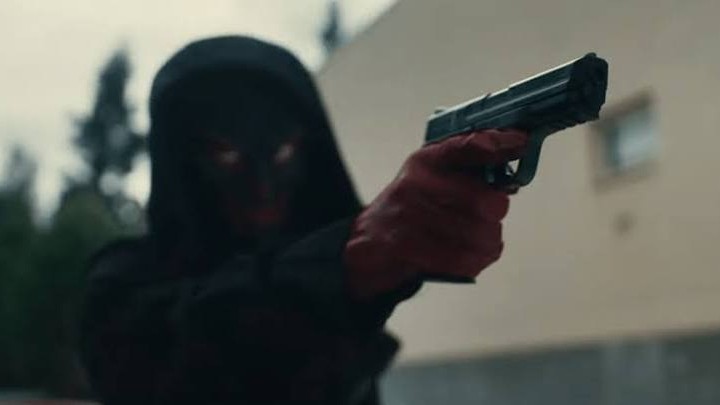
Then the killer steps into view and looks like someone wandered away from a Skyrim convention.
The mask is not intimidating. I understand the problem. Slashers have spent decades putting every possible sack, helmet, animal head, hockey mask and homemade art project onto killers. There is only so much territory left. Sometimes the better choice is reduction. This costume has the opposite philosophy. It looks like something designed for World of Warcraft or Assassin’s Creed, and every clean look at it drains tension from the scene.
The editing creates another problem. Sulek and editor Casey McClelland keep reaching for noticeable transitions, some of which feel like they were kept because somebody was excited to discover them. One transition into Beeps Pizza is particularly wild, and not in a good way. A later one actually works, which only makes the rest harder to ignore.
Holy mother of transitions.
Some of the film has the pacing of online sketch content, constantly cutting or adding a flourish because silence might cause someone to click away. Sulek is not a YouTuber. He is an experienced producer and director. Zach Justice does come from podcasting and online sketch comedy, but he did not direct or write the movie. Whatever the cause, Dead of Night has trouble allowing a moment to breathe. The movie cuts away, explains the moment or announces the next piece of information before any tension has time to settle.
That becomes deadly for a mystery. A whodunit needs information, but it also needs control. Dead of Night keeps throwing names, old relationships, missing photographs, family histories and suspicious behavior into the story until mystery becomes clutter. Sharon is mentioned repeatedly. The Mitchell family history enters the conversation. Donnie is questioned and shown photographs of the bodies in a scene that feels bizarrely casual. Other characters drift in long enough to become suspects or victims.
The Valley Video sequence may be the clearest example. The store itself is cool, and I am always happy to spend time in a video store. The scene introduces a group of disposable characters, gives John Hennigan a role as Boone and then kills them. Remove the entire sequence and the investigation does not change. The characters barely matter before they die and do not matter after.
The dialogue also calls The Return of the Living Dead a sequel, which it is not, at least not to George Romero’s film in the way the conversation appears to mean. A minor complaint, maybe, but if you are going to stop the movie for video-store horror talk, get the horror talk right.
The effects remain the biggest reason to keep watching. Several kills look good, David puts up a respectable fight during his attack and the rooftop reveal near the end is one of the few times the movie’s desire to create a “cool” image genuinely pays off. The problem is that many of these moments feel disconnected from the story. The victims exist because the movie is not ready to kill a main character but believes another body needs to hit the floor.
Eventually, the film attacks Sheriff Weaver’s family and brings the mystery back to Donnie. The father-and-son reveal confirms that Donnie was involved and gives us two killers, because apparently the Scream influence had not been clear enough already. The movie then tries to justify the murders through old grievances and family history before allowing a news report to explain whatever remained.
Having two killers is not automatically a problem. Neither is building a modern slasher out of the structure of ’90s horror. That period produced some great movies and a larger number of glossy imitations. Dead of Night knows the playbook, but it rarely finds its own reason for running the plays.
The mystery should make earlier scenes clearer once the masks come off. Here, the reveal mostly confirms that the story was as tangled as it felt. The film spends so much energy trying to keep the audience guessing that it forgets to make the answer satisfying. Confusion is not suspense, and withholding information is not the same as building mystery.
I wanted to like this movie. There is a watchable slasher buried inside it. The cast is better than the screenplay, the effects are often impressive and a handful of compositions show real care. Horror fans looking for practical gore and a deliberately old-fashioned whodunit may find enough here to enjoy.
The dialogue is subpar, the killer is not frightening and too many scenes exist only to raise the body count or show off an idea that should have been cut. Its debt to Scream becomes impossible to ignore, particularly when it arrives at two killers and a lengthy explanation of why they did it.
Dead of Night is worth a watch, but it is also proof that following the slasher playbook and understanding why that playbook works are two different things.
5.9/10
Dead of Night opens in limited theaters November 13, 2026, and arrives on demand January 12, 2027.