By Devin Smock
Critical Screening
SPOILERS THROUGHOUT
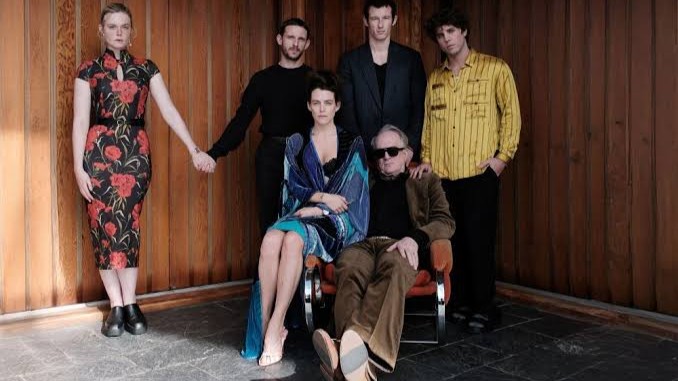
Rosebush Pruning is absolutely stunning before it gives you any idea what the hell it is. Cinematographer Hélène Louvart shoots the Catalonian estate like every room, hallway and piece of expensive furniture has been placed for a purpose. The sunlight is warm, the people are beautiful and the compositions are immaculate. Then somebody starts talking and you realize something is very wrong here.
Jack likes blood. Their mother was supposedly eaten by wolves. The four adult children live in a mansion with their blind father, surrounded by inherited money, designer clothes and no apparent need to participate in the world outside. Nobody in this family speaks or behaves like a normal human being, but it does not take long to understand that this is the point rather than a failure of the movie.
This is part of why I started Critical Screening. I love horror and spend a lot of my life watching it, but after enough movies where “good enough for the genre” is doing some heavy lifting, I occasionally need to watch something constructed at this level. Rosebush Pruning is messy, excessive and at times completely full of shit, but it is made by people with a point of view. Every department appears to be making the same strange movie.
Karim Aïnouz directs from a screenplay by Efthimis Filippou, a frequent collaborator of Yorgos Lanthimos, and the connection makes sense almost immediately. The dialogue is blunt, formal and just slightly disconnected from recognizable human behavior. People say private things with the emotional weight of ordering lunch. They discuss sex, death, money and family loyalty as if they learned about human beings from an instruction manual with several important pages missing.
That style can become exhausting when it is only weird for the sake of being weird. Here, at least for most of the movie, it works. The dialogue is very funny because nobody in the film seems aware of how funny they are. The movie never nudges the audience or stops to explain the joke. It puts these damaged, privileged people in a room, lets them speak and trusts the discomfort to do the rest.
The basic setup is simple enough. Jack, played by Jamie Bell, wants to leave the family estate and live with his girlfriend, Martha, played by Elle Fanning. That would be a normal adult decision in almost any other family. In this house it is treated like an act of treason. Jack is the load-bearing wall holding together a family that should probably have been condemned years ago, and his attempt to leave gives everyone else permission to fall apart.
The introduction of Martha is uniquely uncomfortable. She enters this sealed little world as the closest thing the movie has to a regular person, which only makes the family look stranger. The dinner scene is so fucking awkward that it becomes funny, then disturbing, then somehow funny again. Tracy Letts, as the blind and deeply controlling father, asks invasive questions with the casual confidence of a man who has never once been told to shut up. Riley Keough’s Anna sees Martha as both an intruder and a threat. The rest of them inspect her like she is a new appliance Jack brought home without asking.
Fanning is great because she does not try to compete with the family’s eccentricity. Martha is uncomfortable, but she is not weak or stupid, and Fanning lets us see her trying to decide how much of this behavior is rich-family awkwardness and how much is actual danger. Her monologue at the funeral is especially good. The circumstances are bizarre, but the feeling underneath it is recognizable. That little piece of honesty lands harder because it has been dropped into a movie where almost everybody else communicates through performance, manipulation or some deeply unhealthy appetite.
The entire cast commits. Callum Turner gives Ed a mixture of emptiness, curiosity and quiet menace that keeps changing underneath the movie. Jamie Bell makes Jack feel like the only sibling who might be able to function in the real world, although “might” is carrying a lot of weight there. Keough is hilarious and vicious as Anna, a wealthy woman whose confidence in her own talent has never had to survive contact with an honest audience. Lukas Gage takes Robert’s need for his brother to a place that confirms the incestuous feeling hanging over the house almost from the beginning.
Then there is Pamela Anderson. The mother initially exists as a family legend, supposedly killed by wolves and preserved through a grotesque kind of worship. Anderson gives the role an odd warmth that makes the truth about her feel even more complicated. She is not in the movie as much as the marketing might lead somebody to expect, but she makes her time matter. Her ultimate fate is brutal, sudden and another reminder that this family can turn love into a weapon without even changing the tone of its voice.
The scene involving the wolves is kind of silly, but in the best possible way. That applies to quite a bit of Rosebush Pruning. It is not presenting the rich as realistic people who happen to make bad decisions. It treats extreme wealth like a terrarium. These people have been sealed off with one another for so long that money, sex, affection, jealousy and control have all started growing together. They can buy anything except a boundary.
There is also a family ritual involving the father, one of his sons and dental hygiene that becomes one of the more disturbing things I have watched in a while. I do not even feel the need to explain it in detail. If you have seen it, you know. If you have not, there are some experiences a critic should allow a movie to provide personally.
Louvart’s cinematography keeps all of this elegant even when the people and behavior are anything but. The house is luxurious without ever feeling comfortable. It resembles a showroom nobody knows how to leave. Aïnouz and Louvart use its windows, reflective surfaces and open spaces to keep family members watching one another. The bright Catalonian sun does not expose the truth so much as make the rot easier to see. Even when the story becomes muddy, the frame usually knows exactly where it wants us to look.
The movie felt startlingly original while I was watching it, although it is important to note that it is loosely based on Marco Bellocchio’s 1965 film Fists in the Pocket. Original does not have to mean nobody has ever touched the material before. Aïnouz and Filippou have made something with its own rhythm, time period and specific form of sickness. I have seen plenty of movies about dysfunctional wealthy families. I have not seen this particular family, and I am pretty thankful for that.
By the final stretch, the rosebush metaphor becomes literal in the ugliest way. Ed decides the family needs pruning and manipulates Robert by imitating Jack’s voice, setting off a chain of murders driven by different mixtures of lust, resentment, control and self-preservation. The truth about their mother comes out. Their father’s power finally fails him. Anna protects herself. One by one, the family begins removing its own branches.
It is wild, elegant, brutal and, in a warped way, emotionally believable. Not believable in the sense that I think this exact series of events would happen, but believable in the sense that every death grows out of something already poisoned inside the family. These people have confused possession with love for so long that murder almost feels like the last available form of communication.
This is also where the movie’s problems become harder to ignore. The flow gets messy, motivations blur and some deaths arrive so quickly that they register more as part of the design than the loss of an actual person. The movie can be so pleased with its own perversity that it forgets to make every shock mean something. Ed’s narration occasionally sounds less like a character thinking and more like a screenwriter trying to manufacture a sentence people will quote later.
The satire of wealth and privilege is not exactly subtle either. The family has money, taste, clothes and absolutely no ability to live. I get it. The movie gets there early, then keeps getting there. Aïnouz is more interested in the people than simply shouting “the rich are bad,” but the film occasionally slips into that easier version of itself.
I had seen that the response to Rosebush Pruning was divided before I watched it, although I avoided digging into the reviews. I understand why some people would hate it. Its emotional distance, bizarre dialogue and uneven structure are not small issues. If you never find the family funny or fascinating, spending 95 minutes trapped in their mansion is going to feel like punishment.
I tend to give a little more room to movies willing to be this odd. That does not make the people who dislike it wrong, and it does not make every strange choice secretly brilliant. The movie is certainly flawed. It is also original in spirit, beautifully photographed, exceptionally performed and disturbing in ways that do not feel pulled from the same tired playbook.
Rosebush Pruning is a fucked-up movie about a dysfunctional family, made with elegance, confidence and just enough actual feeling underneath the absurdity. It loses control of itself more than once, but considering the family at its center, maybe complete control would have been dishonest.
6.8/10
Rosebush Pruning is now streaming on MUBI.