By Devin Smock Critical Screening
SPOILERS THROUGHOUT
Being censored does not automatically make a movie good. It usually makes people more curious, sometimes makes the movie more important and almost always gives it a reputation bigger than whatever is actually on the screen. The Devils has spent more than fifty years buried under that reputation. It was obscene. It was blasphemous. It was butchered by Warner Bros. and censors. Now it is a misunderstood masterpiece and everybody who hated it in 1971 was apparently an idiot.
I land somewhere in the middle, which is probably the least exciting place to land on a Ken Russell movie.
The repertory-house priesthood will probably hate that answer. A movie that was banned, cut, difficult to see and finally restored in 4K is practically engineered for canonization. Add naked nuns and Oliver Reed, and some people are ready to call it a fucking masterpiece before the lights go down. That word gets thrown around so casually now that it often seems to mean “a movie I am excited to have finally seen.” The hype does not make The Devils worse, but it does place a hand on the scale. Calling it very good, singular and deeply flawed can sound like you failed some secret cinephile test.
There are pieces of The Devils that are absolutely masterful. There are compositions, performances and entire sequences that feel like they were dragged out of somebody's nightmare and somehow built at full scale. Then Russell will keep pushing. Another screaming body. Another naked nun. Another instrument going somewhere an instrument should not go. Sometimes the excess is the argument. Sometimes it feels like Russell made the argument ten minutes ago and is now entertaining himself.
That tension is basically the whole movie for me. Ken Russell is somewhere between genius and a weird-as-fuck sadist, often within the same scene.
Set in Loudun, France, during the seventeenth century, the movie follows Father Urbain Grandier, played by Oliver Reed. Grandier is a priest, but not an especially obedient one. He is charismatic, arrogant, politically useful and very comfortable ignoring the sexual rules of his profession. He has hurt people. He has used women. He is not the clean, falsely accused saint that a simpler movie would give us.
He is also one of the few people willing to stand between Loudun and Cardinal Richelieu's attempt to strip the city of its independence. Richelieu wants the fortified walls destroyed as part of his consolidation of royal power. Grandier refuses to cooperate, which turns an already flawed man into a political inconvenience.
At the Ursuline convent, Sister Jeanne des Anges, played by Vanessa Redgrave, has developed a sexual obsession with Grandier despite barely knowing him. She imagines him as Christ. She imagines herself with him. When Grandier rejects the opportunity to become the convent's confessor and secretly marries Madeleine de Brou, Jeanne's desire curdles into humiliation, rage and accusation. She claims Grandier has visited the convent as an agent of Satan and violated the nuns.
That lie gives everybody else exactly what they need.
Father Barre gets a public stage for his exorcisms. Local clergy get proof of the evil they already wanted to find. Richelieu's agents get a legal and religious excuse to remove Grandier. The frightened public gets a devil it can see. Whether anyone is actually possessed stops mattering almost immediately. The accusation is useful, so the accusation becomes true.
That is where The Devils is strongest. Russell understood that power does not always need people to believe a lie completely. It needs the lie to produce the desired result. The exorcisms become public entertainment, the entertainment becomes testimony and the testimony becomes permission for the state to torture and kill the person standing in its way. Church and government wash each other's hands in the same dirty water.
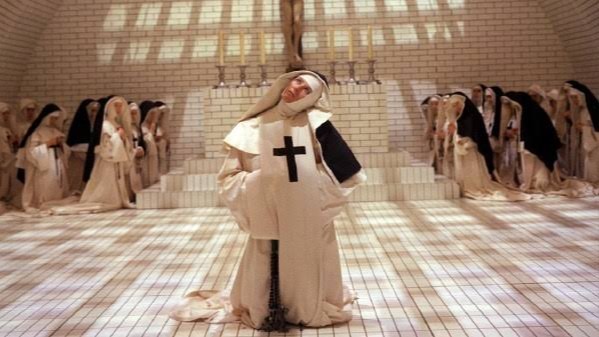
None of this would hit as hard without Derek Jarman's production design, which may be the movie's clearest stroke of genius. Loudun is not the usual muddy collection of medieval buildings. It is an enormous white fortress of hard lines, tiled walls and black columns. At times it looks like a cathedral, a hospital and a public bathroom designed by fascists.
It is outstanding.
The walls initially suggest protection and order, but the whiteness gives every act of violence something clean to stain. Bodies look exposed against it. Blood has nowhere to hide. The architecture dwarfs the people who believe they control it, then becomes the property of whoever controls the story. By the end, destroying the walls is not just a military action. The state is physically erasing the thing Grandier died trying to protect.
Russell and cinematographer David Watkin find one strong composition after another inside those sets. Characters are boxed into doorways, separated by columns or left tiny beneath massive walls. The wide shots are not merely there to show how much money was spent. They establish who holds power in a room before anyone speaks. Even when the movie descends into chaos, the compositions often remain precise enough that the madness has a shape.
Shirley Russell's costumes work for the same reason. The nuns' black-and-white habits almost merge with the architecture until their bodies break the order. Cardinal Richelieu appears almost as a disembodied red presence. King Louis XIII's court looks like wealthy children were given an entire country and decided to stage a cruel pageant. The movie is historically located, but nobody involved seems interested in creating a tasteful museum piece.
Thank God for that.
Peter Maxwell Davies' score sounds sick in exactly the right way. It scratches against the images rather than reassuring us how to feel. During the possessions and exorcisms, the music, screams and tiled rooms become one ugly piece of sound. I can appreciate that construction from a filmmaking perspective even when I am not sure I actually enjoy sitting through it.
Oliver Reed is outstanding in parts and gives the movie its center, especially once it enters the final stretch. Grandier begins as a man who believes charm and intelligence can excuse almost anything. Reed does not soften that. There is confidence in the way Grandier occupies space, but also the sense that he has never seriously considered a world in which charm stops working.
His eventual courage matters because Russell has not made him innocent of everything. Grandier does not deserve what happens to him, but that does not erase the women he used or the hypocrisy of his life. Once the machinery closes around him, Reed strips away the swagger without turning Grandier into a whimpering martyr. His final refusal to confess has weight because it may be the first time the man fully accepts the cost of standing for something beyond himself.
The trial, torture and execution are where Reed becomes genuinely great. Grandier's body is being destroyed while his certainty becomes stronger. Reed does not try to compete with all the screaming, fire and lunacy Russell has built around him. Some of his best work comes when there is almost nothing left for Grandier to do except look at the people who have decided to destroy him. The performance becomes quieter while the movie gets louder. By the time they drag him toward the stake, Grandier no longer feels like the arrogant priest we met at the beginning, not because the movie has forgiven everything he did, but because he has finally found the thing he will not surrender. It is probably the closest The Devils comes to genuine tragedy.
Vanessa Redgrave is operating at the other end of the temperature gauge. Sister Jeanne is desire, shame, jealousy, self-hatred and religious terror packed into one person. Redgrave commits completely, including to moments that must have been incredibly difficult to perform without any guarantee Russell would protect the character from becoming a grotesque joke.
Sometimes he does. Jeanne's fantasies reveal a woman whose faith has given her no healthy language for her body or desire. Her spinal disability has become part of how she sees herself as undesirable and unworthy, and Redgrave finds real pain inside that. Other times Russell seems more interested in bending her body into another shocking image. The movie can recognize how Jeanne has been deformed by repression while also treating her as part of the freak show.
That problem extends to the nuns as a group. Their repression, isolation and vulnerability make them easy targets for the men who arrive claiming to save them. Yet the camera also enjoys their nudity, hysteria and degradation. Russell wants the orgy to expose what institutional repression has created, but he also very clearly wants to film an orgy of nuns.
Both things can be true.
The restored “Rape of Christ” sequence is the clearest example. The nuns tear down and sexually desecrate a crucifix while Barre's religious spectacle collapses into mass frenzy. I understand why Russell considered the scene central. The authorities claim to be defending Christ while manufacturing the conditions for Christ's image to be publicly debased. Their cure creates the blasphemy they need as proof.
It is also Russell filming naked women writhing over a crucifix with enough enthusiasm that the political explanation starts feeling like a permission slip.
This is where the masterpiece argument loses me a little. Russell's excess is purposeful until it is not, and The Devils does not always know when the point has landed. Father Barre, played with impressive commitment by Michael Gothard, storms through the movie like an exorcist, rock star and game-show host. He is funny, frightening and ridiculous. After enough screaming, vomiting, enemas and public convulsions, though, the horror can flatten into noise.
The same is true of Grandier's torture. The length and detail deny us the comfort of treating his execution as an abstract historical injustice. We have to sit with what the church and state physically do to a human body. That matters. But Russell is so fascinated by every needle, broken bone and burned piece of flesh that I occasionally stopped thinking about Grandier and started thinking about the filmmaker arranging it.
Maybe that is unfair. Maybe making the audience aware of the person staging the cruelty is part of why the movie remains so upsetting. Still, there is a line between confronting sadism and reproducing it for spectacle, and Russell dances back and forth across that line with bells on.
Dudley Sutton's Baron de Laubardemont is ultimately more frightening to me than Barre because he understands exactly what the hysteria is for. Barre may believe he is fighting Satan. Laubardemont is doing paperwork for political murder. He lets the lunatics scream, then makes sure their screaming serves Richelieu. The movie's ugliest idea is not that religious fanatics can lose their minds. It is that calmer men will watch, take notes and use the results.
The tone is intentionally unstable. Court comedy turns into plague horror. Political conspiracy becomes religious carnival. The carnival becomes torture. Russell can move between those modes with incredible control, but he can also make the film feel like several different movies attacking each other. There are moments of camp that sharpen the hypocrisy and others that make the characters feel less human than the argument needs them to be.
This is not a subtle movie, but I do not think subtlety is automatically a virtue. A quiet, tasteful version of The Devils would probably be a lie. The events are absurd, the institutions are theatrical and the violence is the point. My issue is not that Russell goes too far. It is that he occasionally goes nowhere after getting there.
The history around the film makes it tempting to forgive everything. Warner Bros. and the British censors demanded separate cuts before its 1971 release, removing sexual violence, religious imagery and the entire “Rape of Christ” sequence. The American version was cut further. Some footage was later recovered, while other material is believed lost. The 2026 restoration, assembled from the original camera negative and guided by the version Russell privately constructed in 2004, is the first public release intended to reflect his preferred cut.
That restoration is important. The censorship was wrong. Warner Bros. spending decades treating one of its own major productions like radioactive evidence was ridiculous. None of that requires me to call every restored minute a masterpiece.
The original critics who dismissed The Devils as empty depravity missed the political movie sitting directly in front of them. The modern canonization goes too far in the opposite direction, treating every accusation of exploitation as proof that Russell succeeded and every restored frame as recovered genius. A movie can be politically intelligent and juvenile. It can condemn cruelty while indulging in it. It can contain genius without being a masterpiece from beginning to end.
That is The Devils.
The final movement is brutal and effective because the political scheme becomes physical. Grandier is tortured, denied the false confession that might make the execution appear legitimate and burned alive anyway. After his death, the walls of Loudun are destroyed. The possession story has done its job. The church gets its devil, the state gets the city and the people get ruins.
Sister Jeanne receives one last relic from Grandier's body, turning the person she desired into an object she can possess. It is disgusting, sad and a little obvious, which may be the most Ken Russell ending possible.
I do not think The Devils is the flawless act of cinematic genius its loudest defenders claim. It is too repetitive, too pleased with some of its own cruelty and occasionally more interested in creating notorious images than fully developing the people inside them. But calling it bad would be just as dishonest. The production design alone belongs in the history of great cinematic spaces. Reed, especially during the final act, and Redgrave are fearless. Watkin's photography, Davies' score and Russell's ability to turn politics into physical horror give the film real power.
It is an original, angry, visually astonishing piece of work made by a filmmaker whose worst and best instincts were apparently using the same camera.
For all that, I enjoyed the damn thing. It is too alive and too strange not to.
I admired a lot of it. I was disturbed by some of it. I rolled my eyes more than the masterpiece crowd will appreciate, and I will still be thinking about several of its images long after cleaner, better-behaved movies have disappeared.
That probably counts for something.
7.2/10
The definitive 4K restoration of Ken Russell's The Devils opened in North American theaters on October 16, 2026.